Please let me interact with your blog post!
 Michael Harley
3 min read
Michael Harley
3 min read
I love my RSS reader. It's the first thing I reach for when I'm "catching up." As I'm reading through my list of feed items, I often come across blog posts that do not give me any way to interact with the post!
Here are some options in the order of my own preferences.
Webmentions
The gold standard is webmentions. If I can send your site an interaction, directly from my site, that's the best option. I rolled my own self-hosted RSS reader, based on the look and feel of Feedbin, but I built in the ability to send a webmention like or comment.
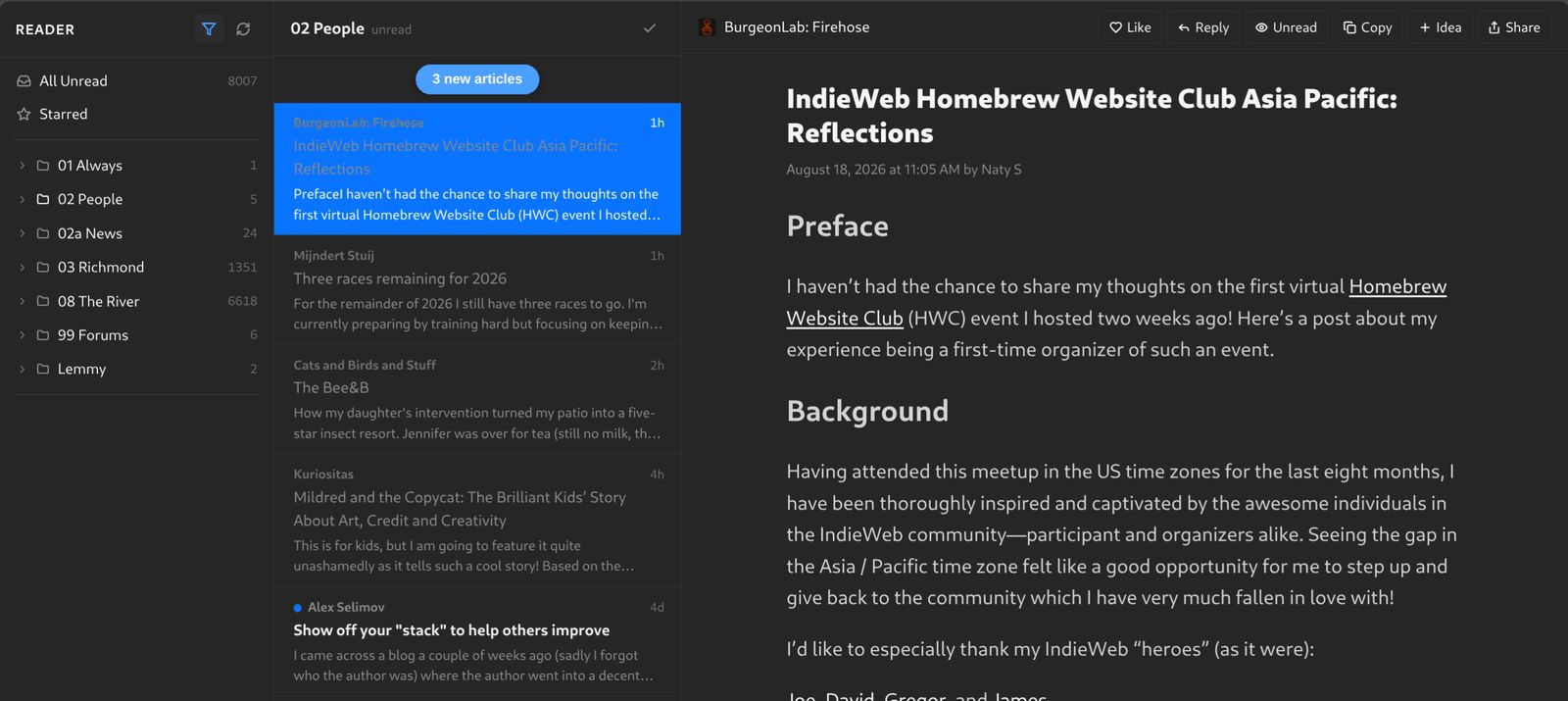
If you look up in the upper right corner, you can see BurgeonLab does support webmentions, so I can click the like or reply buttons directly from here, and that sends the webmention. This is one of my favorite features on my reader.
Reply email link directly in feed
Ok, so not everyone wants to mess with implementing webmentions. It's fiddly and kind of hard to understand, so I get it, but I see several people putting the Reply email link directly in their RSS feed item. That's also really cool and convenient!
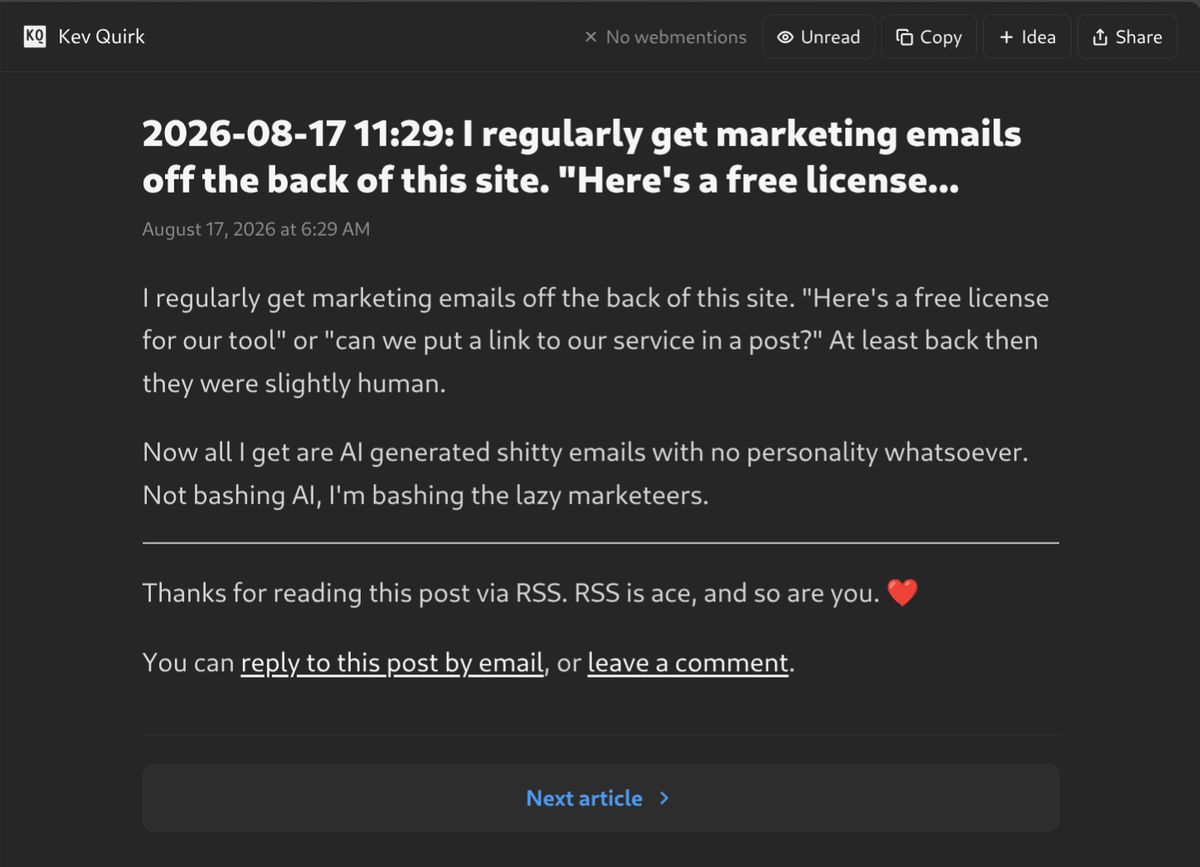
Kev Quirk does this perfectly. If you can't support webmentions, then this is a very close 2nd!
Reply email link at the bottom of your post
Ok, so not as great as webmentions or links in the feed item, but still not too hard to reach for if I really want to send some feedback. I personally prefer an email over a comments form, but I'll take either.
I've seen many implementations of this, but it's basically just a mailto link that prepends Re: to the post title.
Social media links to the blog post
People, myself included, syndicate their blog posts to social media like Mastodon, where discussions can happen. Replying via email or replying to the Mastodon post are both OK in my mind.
Contact page or form
Bleh. My least favorite way. You're really making me work for it now. I have to click through from my RSS reader to your website and then to your contact page/form?! No. Why do you hate feedback, bro?!
Or don't do any of these things! Everyone can blog however they like, so if you don't like what I'm suggesting, well then just ignore it and keep it moving. Or click the conveniently located reply email link to tell me I'm full of crap... or send me a webmention!









Thread
Comments are top of the list surely?
I'd prefer webmentions over all others.
@michaelharley good reminder that I had meant to set up an email link in my post template. Will work on that this week! (Need to set up the email account first 😂)
@michaelharley@infosec.exchange Counter point : purely static html is easy and I'm lazy 😆
I have been contemplating the idea of setting up an old school guestbook of some sort though on my site.
The main reason why I have contact form in a contact page is to prevent spam from actually getting to my email. So if people makes an effort to contact me via contact page form, they are less likely to be a bot or worse case scenario, trolls.
So no "reply by email" or webmention for me. I'm not the biggest fan for it.
I'm more of a contact form (and by extension, guestbooks) person than an email person.
D Dale Mellorʼs Blog via khleedril.org
With you on WebMentions, not so much on e-mails. Publishing an e-mail address on the Internet is a massive invitation to spammers.
As second string, I much prefer a contact form protected with some kind of captcha. It is integrated with the blog back-end (I run a dynamic site), and enforces encryption.
I will say that I hate sites which force you to subscribe to be able to comment. I generally walk away from them.
V ventana via Hacker News
I have a self-hosted comment server on my blog, and it has served me well. In addition, my site also fetches social media discussions.
Someday I will implement webmention, but it's pretty low priority. It is pretty confusing even for someone who has webdev experience. I also have a feeling it is not well known outside the IndieWeb circle, and most people probably don't even know how to use it.
Possibly an unpopular opinion for 2026, but I still prefer comments over email. Not only does it create space for casual readers to jump in, but comments are how blogging olds have always discovered other interesting blogs. I feel we lose that discovery loop if it's all private email.
I really like the idea of making it easier for readers to actually respond instead of just consuming a post and moving on. It reminds me that even something as simple as a reply option can make a blog feel much more personal. I’ve seen the same with a Siemens service center, helpful communication and an easy way to reach someone can make a big difference in the overall experience.
I think one of the most interesting things here is that the method of interaction changes the nature of the conversation itself.
Email is personal and low-pressure, but the exchange effectively disappears from the public web. A comment leaves something behind for the next reader, and that can be valuable even years later. Webmentions go a step further because the response can live on the reader’s own site while still becoming part of the conversation around the original post.
That feels particularly important now that so much online discussion happens inside platforms where the discussion, identity and history of the conversation all depend on somebody else’s system.
At the same time, I completely understand why some site owners deliberately make interaction harder. Every additional channel creates another thing to moderate, protect from spam and maintain. There probably isn’t one ideal solution for every blog.
For me, the best approach is simply to provide at least one obvious path for a reader who has something meaningful to add. It doesn’t need to be technically sophisticated. A simple comment form or reply link can be enough.
And I really like the idea that personal websites can choose different answers to this problem rather than all converging on the same social-media-style interaction model.